Short answer
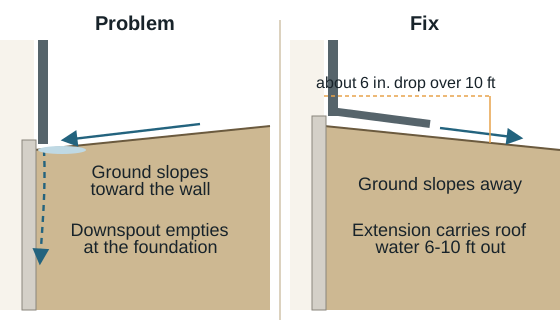
On Anderson's flat lots, roof water dumped at the foundation and soil that slopes toward the house add water to ground that's often already saturated. Downspout extensions, regrading so soil falls about 6 inches over the first 10 feet, French drains and draining window wells fix surface water cheaply. They don't lower a high water table, so they're the first step, not always the last.
Every basement fix works better when less water reaches the foundation. On Anderson’s flat, slow-draining lots, surface water has fewer places to go, so the cheap outside fixes matter.
Signs surface water is your problem
- Water comes in within hours of a heavy rain and stops soon after.
- The wet spot at the floor-wall joint sits below a downspout, a valley in the roof or a low patch of yard.
- Window wells fill during storms, sometimes enough to flood the basement.
- Soil along the foundation has sunk below the level of the yard.
- Water stands in the yard near the house for a day or more after rain.
Water that comes in for weeks in spring, along several walls, is more likely groundwater. That calls for drainage at the footing (interior drain tile), covered below.
Start with the roof
A typical roof sheds a large volume of water in a heavy storm, and downspouts concentrate it at a few corners. If those corners are where your basement leaks, start there.
- Extend every downspout 6 to 10 feet onto ground that slopes away.
- Trace old underground lines. Many older Anderson homes have downspouts piped into buried clay lines that empty at the foundation, have collapsed, or tie into the sewer. Disconnect them at the ground and extend above grade.
- Clean the gutters each fall and spring.
Grade away from the house
Soil should fall about 6 inches over the first 10 feet from the foundation. Decades of settling often leave older yards flat or sloping toward the house. Regrading with compacted soil, not mulch or sand, fixes it. Patios and walks that slope toward the house need the same attention.
French drains
A yard French drain is a gravel trench with perforated pipe that catches surface water and shallow runoff and carries it to an outlet. On flat Anderson lots, finding a lower outlet is the hard part. Some drains end at a pop-up emitter downhill, some at a dry well in better-drained soil, and some at a sump.
Yard French drains typically cost $10-$50 per linear foot, and deeper drains $30-$70 per foot (published ranges; sources).
Window wells
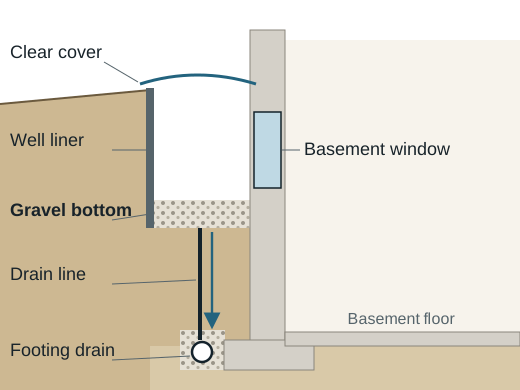
Window wells are a common entry point after storms. Clean out soil and leaves, put several inches of gravel in the bottom, add a drain if there isn’t one, raise the liner above grade, and add a clear cover.
Dry wells and outlets on slow-draining soil
A dry well is a buried pit filled with stone or a plastic chamber that lets collected water soak into the ground. On dense glacial till, water soaks in slowly, and in spring a dry well can fill and stay full just when it’s needed. Pop-up emitters on a lower part of the lot, or an outlet to a ditch where the city allows it, are often more reliable here. Where the soil drains well, a dry well has a better chance.
Where surface fixes matter most
In towns whose sampled ground is mostly well drained, such as Chesterfield and Middletown, groundwater is less often the cause, so downspouts, grading and window wells may be the whole answer (USDA NRCS soil survey). On the wetter till around most of the county, they’re still the first step and the cheapest. Compare towns on the nearby towns page.
What surface fixes can’t do
They don’t lower the water table. In Anderson, the soil survey estimates a seasonal water table within about a foot of the surface under 56% of sampled city land (USDA NRCS). If water still appears at the floor-wall joint in spring after the outside is fixed, the basement needs drainage at the footing: interior drain tile and a sump.
A quick checklist
- Every downspout extends 6-10 feet onto ground sloping away
- No downspouts tied into buried lines of unknown destination
- Soil falls about 6 inches over the first 10 feet
- Patios and walks slope away from the house
- Window wells have gravel, a drain and a cover
- Sump discharge ends 10+ feet out, not near a downspout
Typical costs
| Fix | Typical cost |
|---|---|
| Downspout extensions | Low; often a do-it-yourself job |
| Regrading along the foundation | Depends on how much soil is needed |
| Yard French drain | $10-$50 per linear foot |
| Deeper French drain | $30-$70 per linear foot |
Published ranges from U.S. cost guides (sources).
Who to call
Landscapers and drainage contractors handle grading, French drains and emitters. Gutter companies handle gutters and downspouts. Ask each one where the water will end up, and ask them not to tie anything into the sewer: parts of Anderson have combined sewers, and clean water in them adds to storm overloads. If the sump discharge needs moving at the same time, see discharge and freezing. If seepage still shows up during spring thaws after the yard is fixed, the next step is drainage at the footing.