Short answer
Exterior waterproofing means digging down to the footing, cleaning and repairing the wall, applying a waterproof membrane and drainage board, laying a new footing drain and backfilling. It typically costs $6,000-$25,000 per project. In Anderson it makes sense for wet wall faces or walls that need outside repair, but on a shallow water table the new footing drain still usually needs a sump.
Exterior waterproofing attacks water at the outside face of the wall. It’s the most thorough way to keep a wall dry, and the most disruptive and expensive. On Anderson’s ground, it pays to know exactly what it will and won’t do.
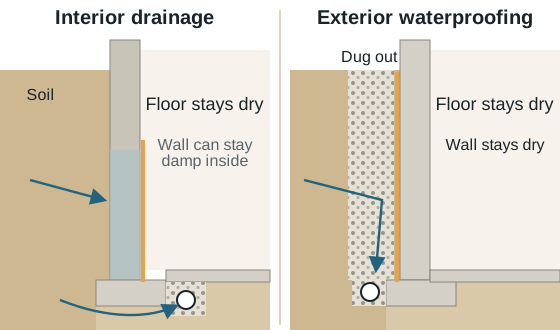
Signs exterior work may be the answer
- A water line or damp band partway up the wall, not just at the floor.
- White mineral deposits high on the wall face.
- One wall that leaks through its face while the others stay dry.
- A wall that needs outside repair anyway, such as straightening or rebuilding. See bowing walls.
- A finished basement where opening up the floor would be costly.
If water instead comes in at the floor-wall joint or up through the slab, that’s water from below, and exterior work alone won’t stop it.
Damp-proofing is not waterproofing
Many older houses got a thin black coating on the outside of the walls when they were built. That’s damp-proofing: it slows moisture, but it doesn’t stop water under pressure, and decades in wet soil wear it away. A real exterior job uses a waterproof membrane, a drainage board and a new footing drain. Ask which one a quote includes.
What the job involves
- Dig a trench along the wall, down to the footing.
- Clean the wall, and repair cracks or damaged block.
- Apply a waterproofing membrane, not just thin damp-proofing.
- Add drainage board so water runs down to the footing instead of pressing on the wall.
- Lay a new footing drain in washed stone.
- Connect the drain to an outlet or a sump, then backfill and regrade.
When it’s worth it in Anderson
- The wall face itself is wet, with a water line partway up or efflorescence high on the wall, meaning water moves through the wall.
- The wall needs outside repair anyway, such as a bowed block wall being excavated to straighten or rebuild. Adding the membrane and drain while it’s open costs relatively little. See bowing walls.
- A finished basement you don’t want to open up, with clear access around the outside.
- One problem wall with easy access, where exterior work on that wall alone may cost about the same as an interior system.
Why it’s rarely enough alone here
Most Anderson basement water comes from below. The soil survey estimates a seasonal water table within about a foot of the surface under 56% of sampled city land (USDA NRCS). An exterior membrane keeps water out of the wall, but water under the slab can still rise through the floor. And on flat till lots, the new footing drain usually has nowhere to empty by gravity, so it ends at a sump anyway. For water rising from below, interior drain tile and a sump pump address it directly, often for less.
Access matters
Driveways, porches, patios, decks, utility lines and close neighbors can make excavation expensive or impossible along some walls. A common answer is a hybrid: exterior work on the accessible wall that leaks through its face, interior drain tile along the rest, and one sump collecting from both.
What to expect during the job
The trench is usually as deep as the basement and wide enough to work in, so plantings, walks and sometimes steps along that wall come out. Most jobs take several days per wall, depending on depth and access. Afterward the soil settles, so plan for topping up and regrading in the following season. Downspouts and grading are rebuilt as part of the work, and the new footing drain usually runs to a sump pump. Our yard drainage page covers how they should end up.
Alternatives and when they’re enough
- Interior drain tile and a sump handle water from below, the common local pattern, for less. See interior drain tile.
- Crack injection from inside seals a single leaking crack in a poured wall. See crack repair.
- Downspouts and grading fix water that arrives only after storms near one corner. Check the cost page for how these compare.
Soils matter here too. Where the ground drains better, as across most sampled land in Middletown and Chesterfield, a new footing drain has a better chance of reaching a gravity outlet. The soils page explains the survey.
Costs
Exterior waterproofing typically runs $6,000-$25,000 per project, depending on depth, wall length, access and how much landscaping and hardscape must be restored. Full-perimeter excavation with a membrane and new drains can exceed that (published ranges; sources).
Questions to ask
- Where exactly is water entering, and what shows that?
- What membrane and drainage board will you use, and how high do they go?
- Where will the footing drain empty?
- What happens to the floor if water also rises from below?
- What will be restored afterward, and what’s excluded?