Short answer
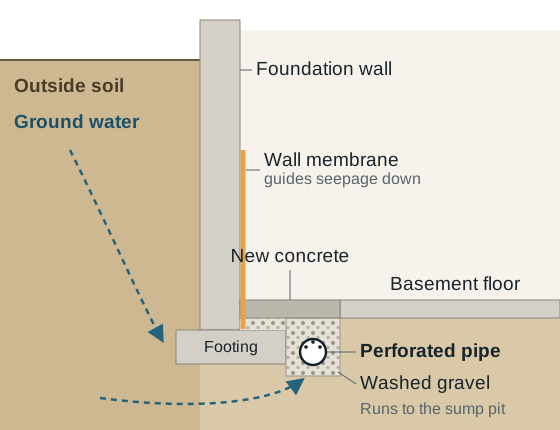
Interior drain tile is perforated pipe laid in washed stone beside the footing, under the basement floor, that collects groundwater and carries it to a sump pump. On Anderson's till soils, where the soil survey estimates a seasonal water table near the surface under much of the city, it's the usual fix for water at the floor-wall joint or through the floor. It typically costs $40-$120 per linear foot.
When the ground around a basement is full of water, the most reliable fix is to give that water an easy path out before it reaches the floor. That’s what interior drain tile does, and on Anderson’s ground it’s the fix contractors reach for most often.
Why it suits Anderson
The soil survey estimates a seasonal water table within about a foot of the surface under 56% of sampled city land, and within 3 feet under 69% (USDA NRCS). Those are estimates for mapped soils, but they describe what many Anderson homeowners see: water arriving from below in late winter and spring, along the bottom of every wall at once. Drain tile collects that water at the footing, the lowest point of the wall, and moves it to a sump pump.
Two other local factors point the same way:
- Old footing drains. About 31% of Anderson homes were built between 1950 and 1969 (U.S. Census ACS 2024). Many have clay tile footing drains that are silted, broken or no longer connected to an outlet. An interior system replaces that drainage without digging up the yard.
- Flat, slow-draining yards. On level till, there’s often nowhere for an exterior drain to empty by gravity, so water ends up in a sump either way.
Signs you need it
- Water along the bottom of several walls in late winter and spring. See water at the floor-wall joint.
- Water rising through cracks in the slab. See water through the floor.
- An old sump pit that stays dry while the edge of the floor is wet.
- Seepage that keeps coming back after the downspouts and grading are fixed.
- White mineral crust (efflorescence) along the lowest courses of a block wall.
How the system works
- A strip of floor about a foot wide is cut away along the walls.
- A trench is dug beside the footing, down to about footing level.
- Washed stone goes in, then perforated pipe sloped toward the sump, then more stone.
- On hollow block walls, small weep holes drain water out of the block cores.
- A membrane on the lower wall directs seepage into the trench.
- The pipe runs to a sealed sump pit, and the floor is re-poured.
The day-by-day version, including what to check before the crew leaves, is in how it’s installed.
Full perimeter or partial?
On much of Anderson’s till, full perimeter is the safer choice, because spring water pushes on all four walls. A partial system fits when the evidence points to one side:
| Situation | Usually |
|---|---|
| Water along all walls in spring | Full perimeter |
| Water rising through the middle of the floor | Full perimeter, sometimes with drain lines under the slab |
| One wall wet after storms, below a downspout | Fix the downspout first, then partial if needed |
| One wall leaking where an old drain collapsed | Partial, if a camera confirms the rest of the drain works |
Partial systems still need a sump pit and pump, so the price gap is smaller than the footage suggests.
How the odds change around Anderson
Ground conditions shift a lot within a few miles. The soil survey estimated a seasonal water table within about a foot of the surface at every sampled point in Fortville and 98% in Lapel, but only 18% in Chesterfield and 10% in Middletown (USDA NRCS). These are estimates for mapped soils, not readings at a particular house. Still, a basement in Lapel or Fortville is far more likely to need drainage at the footing than one in Middletown, where roof water and grading are more often the cause. Every town’s figures are on the nearby towns page.
What it costs
Interior drain tile typically runs $40-$120 per linear foot. A new sump pit and pump adds $800-$2,500, and a battery backup $600-$1,600 (published ranges; all prices and sources). For a 1,000-square-foot basement with about 128 feet of wall, a full-perimeter system with a new pit and a backup works out to roughly $6,500-$19,500 from those ranges. The cost page walks through the math.
Before you agree to a system
- Ask the contractor to show where water enters now, and how the system will catch it.
- Ask how the pump is sized for long spring run times, and what happens in a power outage. See sump pumps and battery backups.
- Ask where the discharge goes. It should end on your lot, well away from the house, never in the sewer. See discharge and freezing.
- Get the walls covered, the footage, the stone and pipe type, the cleanouts and the warranty terms in writing.
When a cheaper fix comes first
If water appears only after storms and only near one corner, check downspouts, grading and window wells before anything else. On Anderson’s flat lots, roof water dumped at the foundation is a common, cheap-to-fix cause. See yard drainage.
Living with the system
- Test the pump each spring and fall by pouring water into the pit, and test the battery backup the same day.
- Keep the cleanouts and the sump lid where you can reach them. Don’t build over them.
- If silt starts showing up in the pit, have the lines flushed through the cleanouts.
- Expect the pump to run often in spring. A pump that runs constantly in a dry summer is worth checking.